
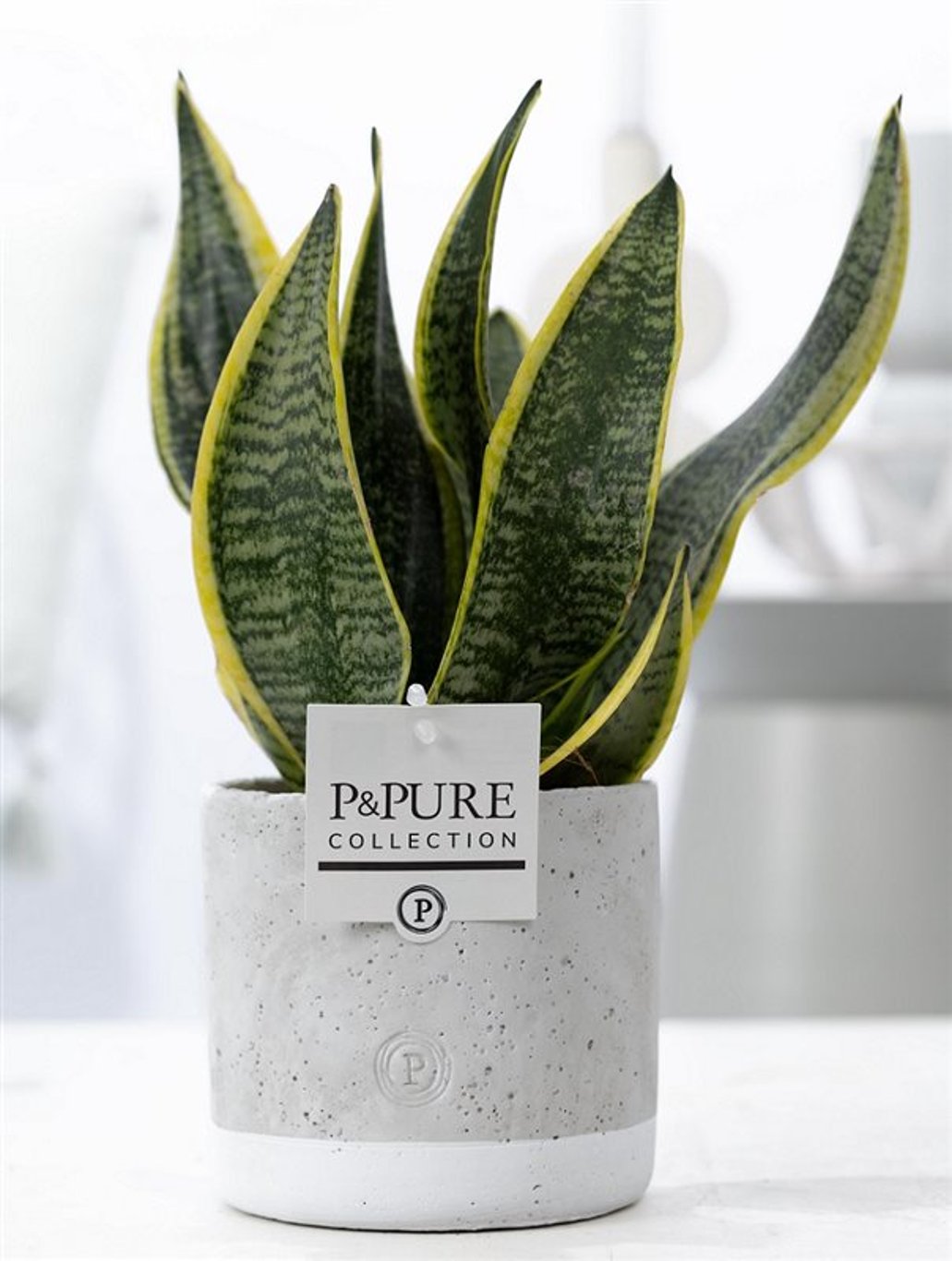

Sansevieria trif. ‘Futura Superba’ in ceramic Jade pot

15.99

The Sansevieria trifasciata ‘Futura Superba’, also known as the snake plant or mother-in-law’s tongue, is a popular, low-maintenance houseplant known for its attractive foliage and air-purifying qualities.

2 in stock

Category:
Appearance & Growth
  • Foliage: It features bold, upright, sword-like leaves with deep green centers, light green horizontal stripes, and distinctive golden-yellow margins.
  • Habit: The plant grows in a compact, irregular rosette pattern, adding a striking architectural shape to indoor spaces.
  • Height: It is a slow-growing plant, typically reaching a height of around 30cm to 90cm (1 to 3 feet) at maturity, with a spread of approximately 60cm (2 feet).
  • Growth Rate: The growth rate is slow to moderate, and it can take 3 to 5 years to reach its full size under optimal conditions.
Care Instructions
This resilient plant is an excellent choice for beginners due to its adaptability and minimal needs. 
  • Light: It is highly adaptable and can tolerate a wide range of light conditions, from low light to bright, indirect light. However, it thrives in moderate to bright indirect light.
  • Watering: As a drought-tolerant succulent, it is sensitive to overwatering. Allow the soil to dry out completely between waterings to prevent root rot. Water even less frequently in the winter.
  • Soil: Use a well-draining potting mix, such as a cactus or succulent mix, which can include materials like perlite or coarse sand.
  • Temperature & Humidity: It prefers average room temperatures between 18-26°C (65-79°F) and does well in normal household humidity.
    • Feeding: Apply a weak, general-purpose or cactus fertiliser once a month during the growing season (spring and summer). Feeding is optional and not required in winter. 
    Propagation
    The 'Futura Superba' variety can be propagated using a few methods, with some considerations for maintaining its unique variegation. 
    • By Division: This is the best method to ensure the new plant retains the characteristic yellow leaf margins. When repotting, separate the offsets (pups) or divide the rhizomes using a sharp, clean knife and repot them individually.
    • By Leaf Cuttings: You can take leaf cuttings and root them in water or soil after allowing the cut end to callus over for a couple of days. Note that new plants grown from leaf cuttings may revert to solid green and lose their variegated edges.
Appearance & Growth
  • Foliage: It features bold, upright, sword-like leaves with deep green centers, light green horizontal stripes, and distinctive golden-yellow margins.
  • Habit: The plant grows in a compact, irregular rosette pattern, adding a striking architectural shape to indoor spaces.
  • Height: It is a slow-growing plant, typically reaching a height of around 30cm to 90cm (1 to 3 feet) at maturity, with a spread of approximately 60cm (2 feet).
  • Growth Rate: The growth rate is slow to moderate, and it can take 3 to 5 years to reach its full size under optimal conditions.
Care Instructions
This resilient plant is an excellent choice for beginners due to its adaptability and minimal needs. 
  • Light: It is highly adaptable and can tolerate a wide range of light conditions, from low light to bright, indirect light. However, it thrives in moderate to bright indirect light.
  • Watering: As a drought-tolerant succulent, it is sensitive to overwatering. Allow the soil to dry out completely between waterings to prevent root rot. Water even less frequently in the winter.
  • Soil: Use a well-draining potting mix, such as a cactus or succulent mix, which can include materials like perlite or coarse sand.
  • Temperature & Humidity: It prefers average room temperatures between 18-26°C (65-79°F) and does well in normal household humidity.
    • Feeding: Apply a weak, general-purpose or cactus fertiliser once a month during the growing season (spring and summer). Feeding is optional and not required in winter. 
    Propagation
    The ‘Futura Superba’ variety can be propagated using a few methods, with some considerations for maintaining its unique variegation. 
    • By Division: This is the best method to ensure the new plant retains the characteristic yellow leaf margins. When repotting, separate the offsets (pups) or divide the rhizomes using a sharp, clean knife and repot them individually.
    • By Leaf Cuttings: You can take leaf cuttings and root them in water or soil after allowing the cut end to callus over for a couple of days. Note that new plants grown from leaf cuttings may revert to solid green and lose their variegated edges.