


Description and Characteristics
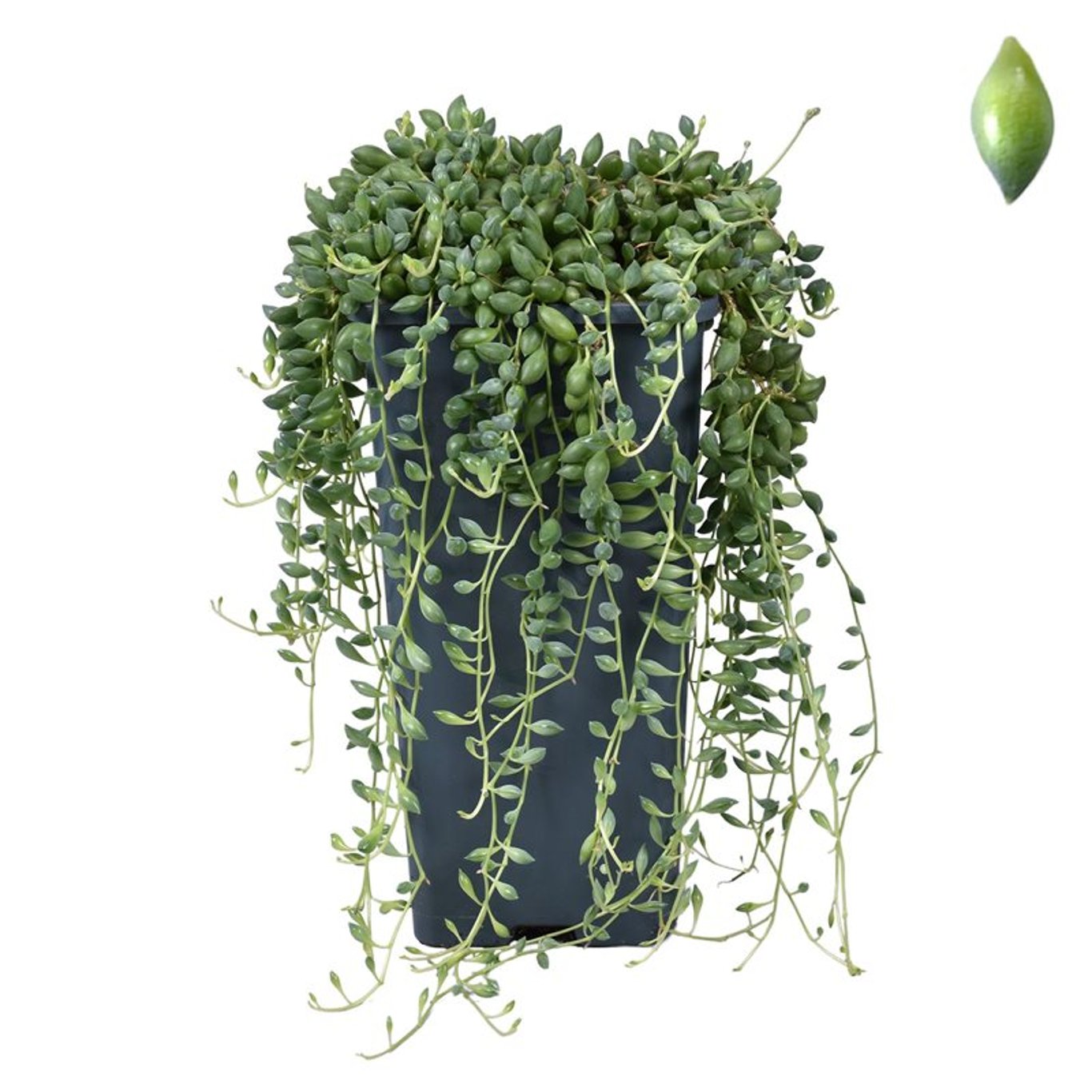
- Foliage: The plant’s main feature is its small, oval, or teardrop-shaped leaves that grow along slender, cascading stems. The leaves are green and often have distinctive purple stripes or accents, resembling miniature watermelons.
- Growth Habit: It is a fast-growing, evergreen perennial succulent with a trailing or mat-forming habit. Stems can trail up to 2 feet (60 cm) or more in length.
- Flowers: The plant produces small, inconspicuous, daisy-like white flowers (sometimes with pink accents) in the summer months, which may have a pleasant, slightly cinnamon-like fragrance.
- Toxicity: According to multiple sources, this plant is considered mildly toxic to humans and pets (cats and dogs) if ingested and should be kept out of reach.
Care Instructions
- Light: Prefers bright, indirect light but can tolerate a few hours of direct morning sun. Too much harsh afternoon sun can cause leaf burn.
- Watering: As a drought-tolerant succulent, it stores water in its leaves. Water sparingly using the “soak and dry” method, allowing the soil to dry out completely between waterings to prevent root rot.
- Soil: Requires a well-draining soil mix, such as a cactus or succulent potting mix amended with perlite or coarse sand.
- Temperature & Humidity: Thrives in average room temperatures between 18-24°C (65-75°F) and prefers low humidity. It is not frost-tolerant and should be protected from temperatures below 40°F (4°C).
- Pruning & Propagation: Prune leggy or tangled stems during the growing season (spring/summer) to encourage fuller, bushier growth. It propagates easily from stem cuttings.
Common Name Confusion
Senecio herreianus is often confused with Senecio rowleyanus (String of Pearls) due to shared common names like “String of Beads”. The key difference is the leaf shape: S. herreianus has more elongated, tear-shaped, or oval leaves with a distinct point, while S. rowleyanus has perfectly round, spherical leaves.